


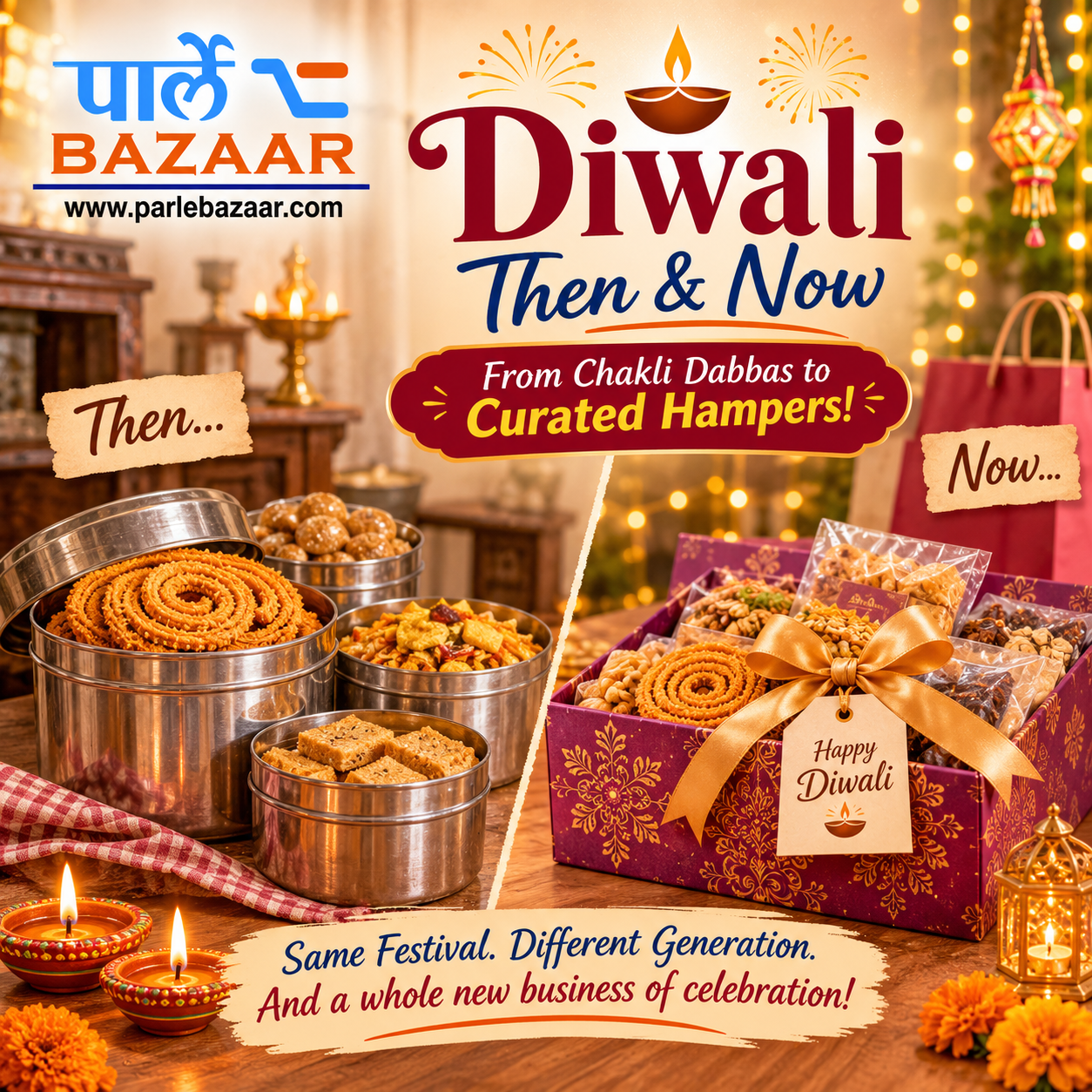
Diwali Then & Now: From Chakli Dabbas to Curated Hampers!
Same festival. Different generation. And a whole new business of celebration!
Remember the Diwalis when the biggest crisis in the house was whether the chaklis would turn out crisp enough, or whether the karanjis would open up while frying? The kitchen was a battlefield, the dining table was a faral factory, and mothers were the unquestioned CEOs of the entire operation.
There were no fancy hampers, no artisanal labels and certainly no Instagram-worthy packaging. Just steel dabbas filled with homemade chakli, chivda, laddoos and shankarpali. These travelled from one home to another, often returning with a different dabba and a generous helping of someone else’s faral. Nobody counted calories. Nobody checked ingredients on an app. You ate, complimented the cook and asked for the recipe – even if you had absolutely no intention of making it!
Diwali shopping was equally dramatic. A family outing to the market meant tired fathers carrying bags, mothers negotiating prices with Olympic-level determination and children developing sudden, expensive preferences. The shopkeeper was often a familiar face. He knew your family, your budget and sometimes your taste better than you did.
And the crackers? That was an entirely different economy. Children negotiated their budgets, compared purchases and guarded their collections like valuable investments. A packet of phuljhadis could produce more excitement than an expensive smartphone does today.
Welcome to Diwali 2.0!
Fast-forward to today. The chakli may still be homemade, but the faral hamper has a designer ribbon, a personalised tag and a price that could make the original cook reconsider her career choices!
Shopping has become wonderfully convenient. Why battle traffic when an outfit can arrive at your doorstep? Why visit five gift shops when an entire catalogue is available on your phone? A few swipes, a discount code, a digital payment and your Diwali shopping is almost done.
Almost. Because there is always one more person to gift, one more party to attend and one more outfit that looks absolutely essential.
The business of Diwali has also grown up. Sweet shops have become gifting brands. Home bakers are creating impressive festive collections. Boutiques are competing for attention through reels, influencers and WhatsApp broadcasts. Decorators, florists, event planners and small entrepreneurs are all finding their own place in the festive marketplace.
The traditional shopkeeper now has a digital competitor, sometimes in the form of a teenager operating an Instagram business from her bedroom. Who would have imagined that a home kitchen could become a festive enterprise?
The Business of Making People Happy
For businesses, Diwali is much more than a few busy shopping days. It is an opportunity to reach new customers, showcase products, introduce festive collections and strengthen relationships with existing ones.
A thoughtful festive offer, an attractive display, a beautifully presented hamper or a personalised gift can make a business stand out in a crowded marketplace. In neighbourhoods like Vile Parle, where familiar shops and established businesses are part of everyday life, the festive season also brings opportunities for local entrepreneurs to connect with new customers.
Digital platforms have added another dimension. A local boutique can reach customers through Instagram, a sweet shop can accept WhatsApp orders, and a small home business can find buyers beyond its immediate neighbourhood. The possibilities are no longer limited by the size of the shop or the number of people walking past it.
But amidst all the new-age marketing, one thing hasn’t changed: customers appreciate good products, fair prices, reliable service and the feeling of being valued.
And perhaps that is where the old and new Diwali meet. The packaging may have changed, but the intention remains the same – to make someone feel remembered.
So, Have We Lost Something Along the Way?
Perhaps a little. The spontaneous visits, the unannounced faral exchanges, the long conversations with neighbours and the excitement of discovering a handwritten greeting card in the letterbox are not quite as common.
But let’s not romanticise the past too much. We also remember the traffic, the crowded markets, the endless cleaning and the mountains of utensils after Diwali parties!
Today’s generation has its own pleasures. It can send gifts across cities, support a home-grown brand, discover a new local business and bring the world into its living room.
Maybe the secret is to borrow the best from both generations.
Make the chaklis if you enjoy making them. Order the hamper if you don’t. Visit your favourite neighbourhood shop, but don’t feel guilty about shopping online. Enjoy the festive offers, explore new brands, and perhaps give that small local business a chance. Send a WhatsApp greeting, but pick up the phone and speak to someone you haven’t met in ages.
And while we are busy celebrating, let’s remember the small businesses and familiar faces that make our neighbourhood festive.
Because Diwali is not just a festival of lights. It is also a festival of livelihoods, enterprise, generosity and relationships.
And this is what makes a neighbourhood special – its people, its familiar shops and the businesses that grow alongside the community. Platforms like ParleBazaar.com make it easier to discover local businesses, explore products and services, and connect with entrepreneurs around us. Through Parle Business Connect, we celebrate these businesses and the people behind them, bringing local brands closer to the community they serve.
The steel dabba may have become a designer hamper, and the handwritten card may have become a digital message. But the real luxury of Diwali remains unchanged – having people to share it with.

